

In the World of Wassily Kandinsky: Where Color, Circles & Creativity Collide
In the World of Wassily Kandinsky: Where Color, Circles & Creativity Collide// There are certain artists whose work seems almost naturally made to be explored through the eyes of a child, and Wassily Kandinsky has always been one of them.

His bold use of color, shape, line, movement & abstraction opens up so many possibilities for young children because there is no single object they are expected to see and no one “right” way to interpret what is in front of them. His work invites us to notice, wonder, feel & imagine.
Kandinsky was a Russian painter & art theorist who became one of the great pioneers of abstract art. Rather than trying to make paintings look realistic, he explored how color, shape & composition could communicate feelings, ideas & even sound. He believed colors carried their own expressive qualities and was especially fascinated by the relationship between art & music.

That freedom is one of the reasons I have loved introducing his work to young children throughout my career.
Introducing children to famous artists has never been about asking them to recreate a masterpiece or make something that looks exactly like the original. Instead, it is an opportunity to expose children to a new way of seeing, introduce them to an artist's unique ideas & then provide materials that allow them to explore those ideas entirely in their own way.
And Kandinsky gives us SO much to explore. Circles within circles. Bold colors. Lines. Shapes. Layers. Movement. Balance. Pattern. Music. Emotion.
Over the years, I have taken his artwork far beyond simply looking at a painting. We have painted, printed, layered, arranged, stacked, built, collaborated & experimented with circles in countless forms.
Some of our favorite Kandinsky-inspired invitations:
1. Kandinsky-Inspired Circle Bouquets: After exploring Kandinsky's artwork & reading stories about his life, we invited the children to experiment with printmaking, painting, layering & sculpture to create whimsical circle bouquets.

Children painted and printed onto circles of different sizes, layered them together from small to large & transformed their creations into three-dimensional bouquets using craft sticks and handmade air-dry clay vases.
What began with Kandinsky's circles became something completely new in the hands of the children: colorful sculptural bouquets created by tiny artists.
2. Kandinsky Circle Exploration: For this exploration, we took the circle the shape so closely associated with Kandinsky's work and investigated it through two completely different open-ended experiences.

In one invitation, children worked collaboratively across black paper using recycled and precut circles, paper materials, pipettes & vibrant liquid watercolors. They layered, dripped, blended & overlapped their creations until individual explorations became one large collaborative work of art.

Alongside it, we created a loose parts circle exploration on a mirrored magnetic sensory surface. Acrylic circles, wooden hoops, stacking pieces, geometric shapes & other open-ended materials invited children to arrange, balance, stack, pattern & redesign.

There was no finished example to follow and no predetermined outcom, just materials, inspiration & the freedom to explore.
3. Three Ways to Explore Wassily Kandinsky: One of my favorite things about using a famous artist as inspiration is discovering just how many different directions one idea can take.
Through our 3 Ways to Wassily explorations, children were given opportunities to investigate Kandinsky's distinctive use of color, circles, shapes & abstract composition through multiple creative processes.
Rather than creating one traditional “Kandinsky craft,” each invitation provided another way for children to encounter his work through hands-on experimentation.
4. Kandinsky-Inspired Circle Prints: For this invitation, I gathered an assortment of plates, recycled round caps & circular tools in different sizes and paired them with colorful paint.

Children were invited to dip the different circular objects into the paint and press them onto paper, experimenting with overlapping, layering & nesting circles inside one another to create concentric circle-inspired artwork.
I especially love process art experiences like this because the materials provide a connection to Kandinsky's work without dictating what the finished piece should look like. Children could repeat, overlap, layer & experiment with the circles however they chose, discovering along the way how an everyday recycled object could become an unexpected art tool.

5. Kandinsky-Inspired Loose Parts: This invitation took Kandinsky's circles, lines & abstract compositions off the page and into loose parts play.

I created two different bases to encourage children to investigate his work in new ways. On the first, I drew simple Kandinsky-inspired outlines and designs. Children were invited to trace, follow & build along the lines using an assortment of colorful loose parts, interpreting the designs however they chose.

For the second invitation, I used mirrors as the base, giving children a completely blank canvas for creating their own Kandinsky-inspired arrangements with loose parts. The mirrored surface added another dimension to the experience as the children's circles, colors, shapes & patterns were reflected back at them.
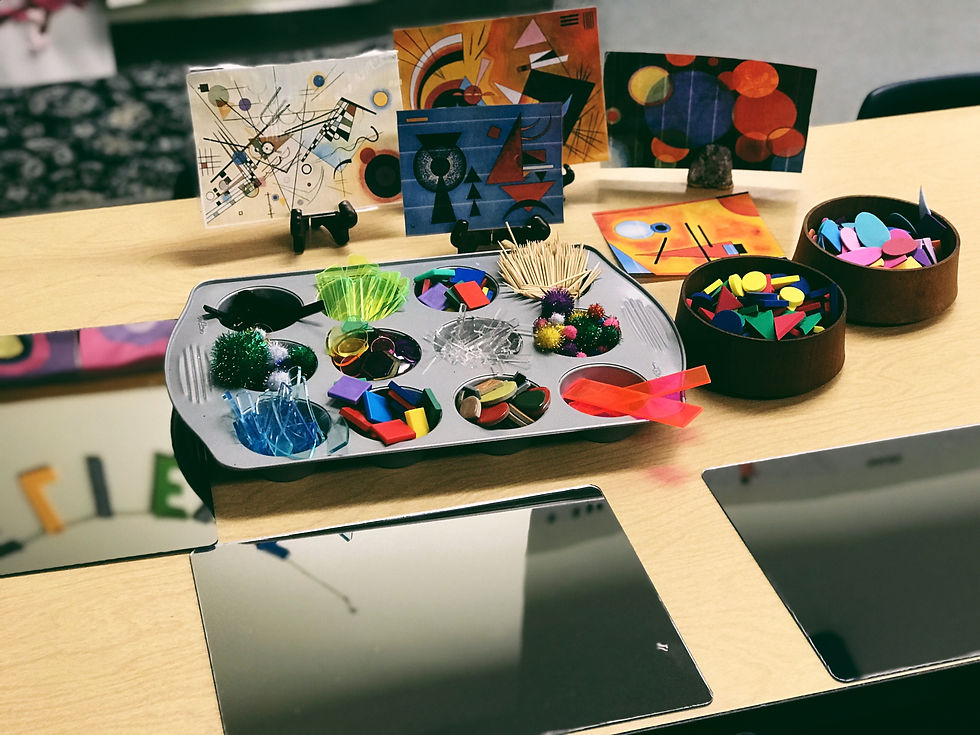
The reflection made even the simplest arrangements feel transformed, encouraging children to notice symmetry, repetition, color, pattern & composition as they continually arranged and rearranged their designs.
And because nothing was permanent, children could create, take apart & begin all over again.
6. Invitation to Paint in Concentric Circles: Sometimes the simplest invitation leaves the most room for creativity.

For this experience, I drew outlines of circles and Kandinsky-inspired compositions onto paper and paired them with an assortment of colorful paints.
Rather than asking children to copy Kandinsky's colors or recreate one of his paintings, the outlines simply becam e a starting point. Children were invited to freely paint within, around & across the concentric circles, choosing their own colors and deciding how they wanted their compositions to evolve.
Some carefully followed the shapes while others painted beyond them, blended colors together or completely transformed the original design.

The result was an invitation that offered just enough inspiration while still leaving plenty of space for individual expression, experimentation & creative freedom.

When we introduce children to artists like Kandinsky, we aren't teaching them how to make a Kandinsky.
We are showing them that art doesn't have to look like something familiar. A color can represent a feeling. A shape can become an idea. A line can move across a page like music. And the same inspiration can become something entirely different in every child's hands.
Kandinsky once described color as having the power to directly influence the soul, and more than a century later, his extraordinary world of color, circles, lines & shapes continues to invite new generations of little artists to look closer, wonder deeply & create freely.
And that is exactly what art should do. That is where the magic is.


Comments